A Film Without Words: Karl Doran on Making Releasing Hope
When the World Mosquito Program set out to create Releasing Hope, a wordless animated film about dengue, community resilience, and the Wolbachia method, they turned to Manchester-based studio Flow Creative to help bring it to life.
Karl Doran, Founder and Creative Director, guided the project from brief to screen, navigating the challenge of telling a complex public health story through visual storytelling alone, scored by acclaimed Danish band Efterklang. In this interview, Karl reflects on the creative and technical process behind the film: from developing a hero's journey narrative accurate to the science, to the animation techniques that give the spectre of disease its unsettling life.
The result is a four-and-a-half-minute film designed to speak across borders, cultures, and languages to audiences in all 16 countries where WMP works.
Interview with Karl Doran, Founder and Creative Director, Flow Creative | Behind the Film
What was it about the project that stood out for you in its early stages?
This was a dream project for us in lots of ways. As soon as we started talking to the World Mosquito Program we knew this was a great opportunity to create a powerful and beautiful animated film, but also to help effect a huge positive change in the world. We've always believed in the power of creativity to make the world a better place and have worked with lots of charities and NGOs over the years, so this project felt like a really good fit for us right from the start.
We hadn't heard of WMP or the Wolbachia method before this, but once we found out about the numbers of people affected globally by mosquito-borne disease and the potential of this method to save literally millions of lives, we knew we had to be involved.
What did you think of the initial challenge of making something that is both universal and involves no dialogue?
An important part of the brief from the start was the requirement that the film have no words, instead relying on visual storytelling, music and sound design. WMP works in 16 countries all over the world, so it was important that there weren't any language barriers when distributing the film. To tell a complex story like this, involving cutting-edge science that audiences will likely not be familiar with, and make it accessible and emotionally engaging without any words, was a big challenge.
We worked closely with the WMP team and with a wonderful writer, Michelle Collier, to develop a narrative that would be true to the science, tell a human story authentic to the experiences of people living with these diseases, and would work without dialogue or voice-over.
Working with the fantastic and highly acclaimed band Efterklang on the score made a big difference too. The music they composed helps to drive the emotional journey of our hero character, and adds a poignant and powerful feel to the film.
"To tell a complex story like this, involving cutting-edge science that audiences will likely not be familiar with, and make it accessible and emotionally engaging without any words, was a big challenge."
Karl Doran, Founder and Creative Director, Flow Creative
What animation techniques or tools are central to achieving the overall look of the film?
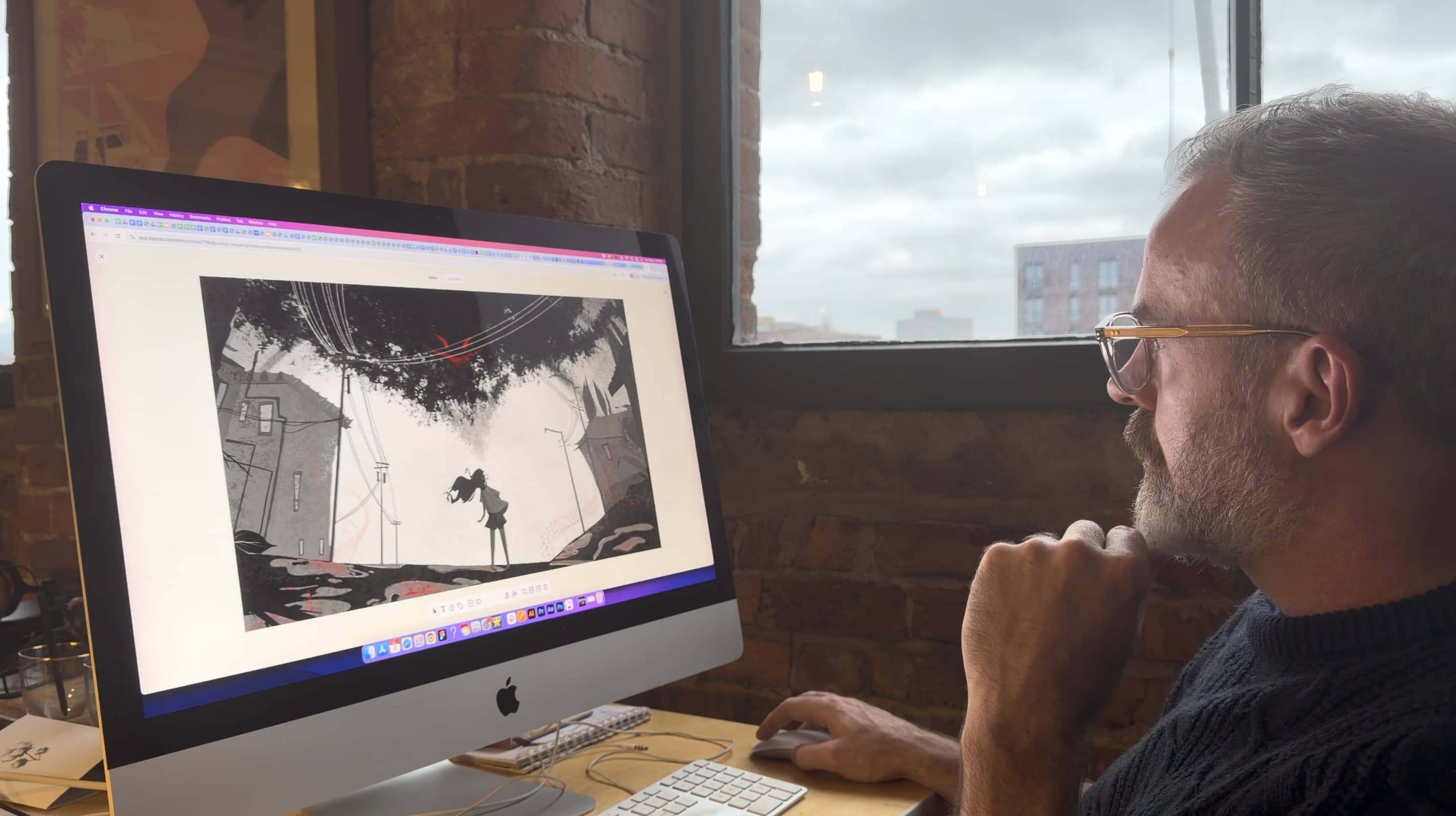
This film combines a number of animation techniques and processes. All of the artwork is hand-drawn by the fantastic artist Eleonora Asparuhova, then rigged and animated by the Flow team in After Effects and Moho. The spectre is modelled and animated in 3D using Cinema 4D, with particle simulations created using Trapcode Particular and Stardust. We also used frame-by-frame animation in many shots, as well as creating lots of elements in 3D then rendering in 2D, like the motorbike and the girl's cape.
It was very much an experimental process that took some research and development to work out the most effective way to create the look we wanted for the film. The most important thing was that the end result felt believable and natural, and that the tools we used helped to tell the human story rather than get in the way of it.
How important is movement, colour, and pacing in this film to express emotion and a powerful human story?
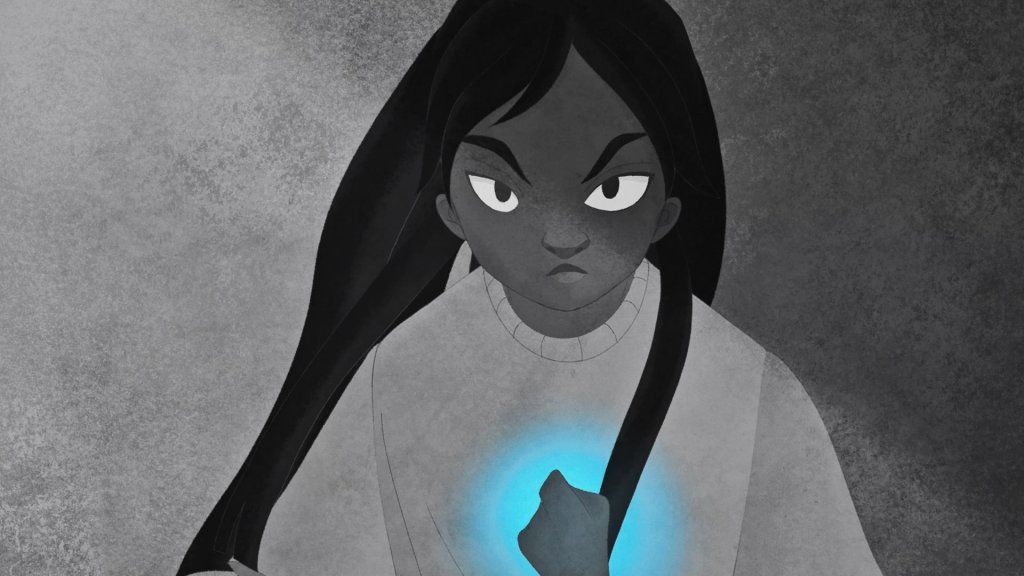
The use of colour in the film is limited to black and white, with red to depict the danger of mosquitoes, and blue for Wolbachia mosquitoes. This gave us a really powerful visual language to work with, with the glowing blue used to signify hope.
| ●Black & white — the world as it is | ●Red — danger, the spectre of disease | ●Blue — Wolbachia, hope |
Seeing this mysterious blue glow, and the work WMP and her community are doing, encourages our hero to act and fight back. Having witnessed the devastation caused by the spectre of disease in her town and in her own family, she bravely fights the spectre, but it's too powerful to defeat on her own. Working together, and with the power of Wolbachia, they manage to overcome it. Throughout the film the source of the blue glow remains a mystery, until at the very end it's revealed to be coming from a mosquito, flipping perceptions of mosquitoes as the enemy and showing they can be part of the solution as well as the problem.
Pacing and timing is an essential aspect of the film, allowing the audience to understand the emotional journey of our hero, the wider issue of mosquito-borne disease, and the power we have to do something about it. We had to ensure the story felt human-first. Telling it from the perspective of the girl helps to humanise it and, hopefully, makes a complex subject feel relatable and emotionally resonant for the viewer.
Were there particular scenes that anchored the pacing or defined the story's turning points?
The film establishes the geographic setting at the start, the context of global temperature increases and the growing mosquito population, then we see the reality of living with the spectre of mosquito-borne disease. The first turning point comes when our hero sees her own brother taken ill and decides to act. With the naivety of youth she bravely attempts to fight the spectre, but is knocked back into a dark abyss. At this point in the story all hope is lost - she has tried and failed.
Then the second turning point is when a hopeful blue glow appears in the darkness. This light is coming from Wolbachia mosquitoes and a WMP bike, which leads her to a WMP lab. Seeing the collective action being taken gives her renewed courage and, together with WMP and her community, they do battle with the spectre again.
What do you think are the biggest creative or technical challenges in bringing this project to life?
The first big challenge was creating a story that had humanity and emotion, but was accurate to the science and the reality of people's lives living with these diseases. In many of the interviews WMP had carried out with the communities affected, people spoke of living with the "spectre of disease," or "in the shadow of disease." This gave us the inspiration for how we visualised the spectre.
Creating this spectre as a constantly moving mass of mosquitoes was a huge technical challenge, but it was important that it felt connected to the issue and not an abstract monster. Balancing being true to reality, telling a human story that was relatable and authentic, with the hero's journey narrative and the girl's point of view, was probably the biggest challenge of all.
How do you feel the final film came together, and are you happy with the end result?
I'm really happy with how the film has turned out. In our ten years as a studio this was definitely our most ambitious project, spanning nearly a year from start to finish. Working with WMP was a pleasure — their expertise and passion for the subject were clear from the very first conversations.
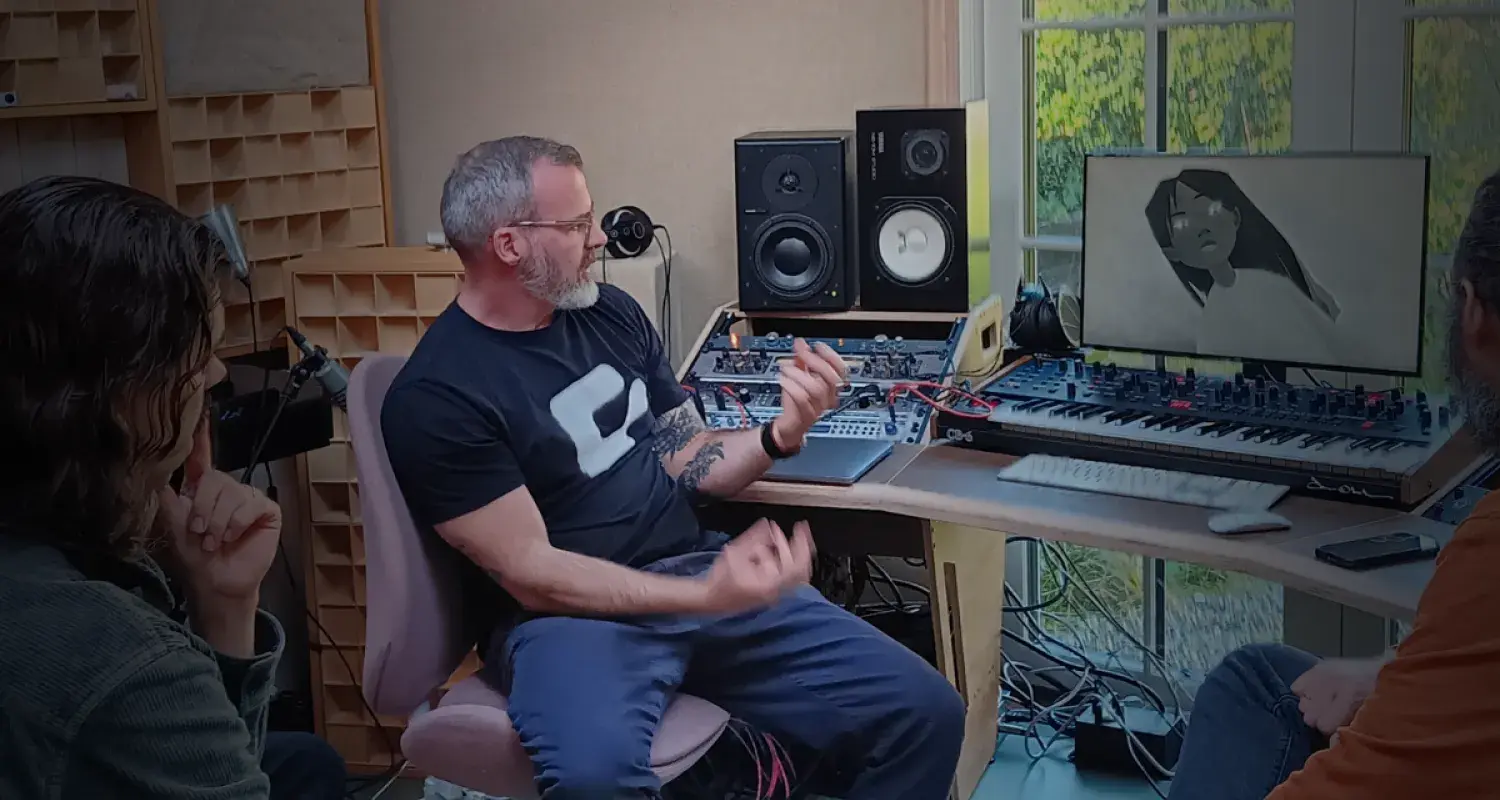
Being able to collaborate with an internationally acclaimed band like Efterklang on the score was fantastic too. Visiting their studio near Copenhagen was a great experience, and the music helps to elevate the film to another level. From our point of view it was a huge technical and creative challenge, but the whole team is really proud of the outcome. We can't wait to see it out in the world, and helping to save lives.
"In our ten years as a studio, this was definitely our most ambitious project, spanning nearly a year from start to finish."
Karl Doran, Founder and Creative Director, Flow Creative
Watch Releasing Hope now
The film is available to watch in full at releasinghope.tv - four and a half minutes, no words, designed to speak to anyone, anywhere.
Watch the film →